
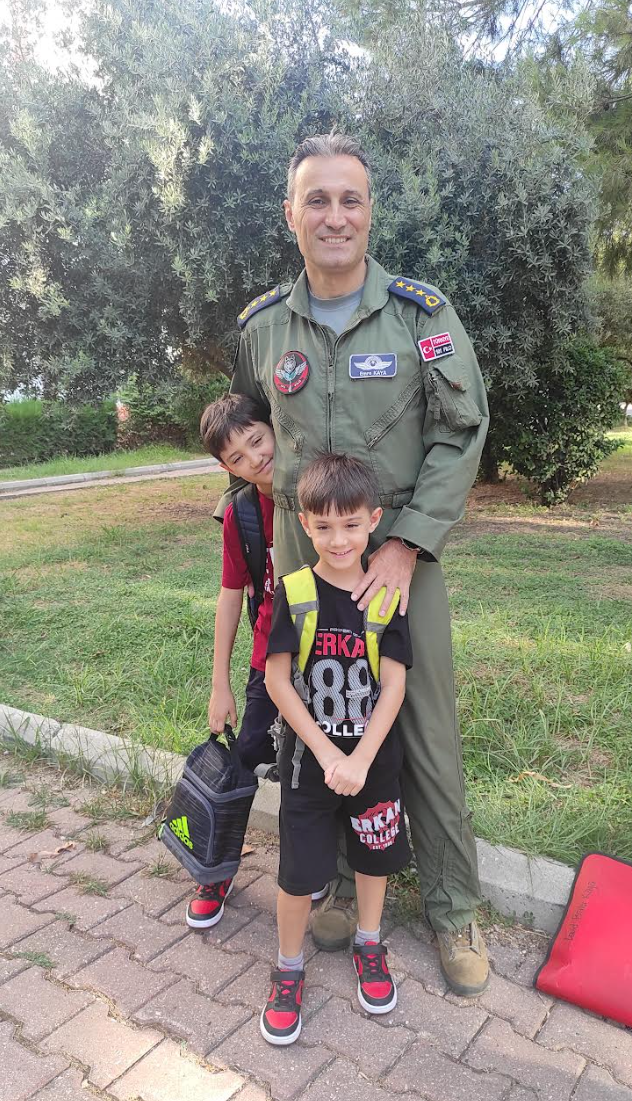
Colonel Kaya received his MS in Space Systems Engineering, Systems Engineering (Certificate Degree) from the U.S. Air Force Institute of Technology (AFIT) in 2008. He joined the military due to a desire to be a jet pilot. After retiring from the Turkish Air Force as a Colonel, he joined Alaska Airlines as a Boeing 737 pilot.
Four years after graduating from the Turkish Air Force Academy, and having been away from intensive math and physics for some time, Colonel Kaya was amazed at how quickly everything came back after a short crash course at AFIT. It reminded him that deep foundational knowledge never really disappears—it just needs the right trigger.
Another defining experience for Colonel Kaya at AFIT was the mini-satellite group project he worked on with his classmates. At first, the scope felt overwhelming, but with time and exceptional teamwork, they achieved results that far exceeded their expectations in a surprisingly short period. That project became a lasting example he often uses to reinforce the importance of collaboration and trust within a team.
Finally, Colonel Kaya was proud to see his thesis work becoming reality after 17 years. NASA’s Artemis II mission will send the Orion Crew Exploration Vehicle to the Moon, and his thesis focused on the return and atmospheric entry trajectory of the Orion CEV. Seeing concepts he once studied on paper now implemented in an operational space mission was incredibly rewarding for him.
As a NATO officer, Colonel Kaya had the opportunity to study and work side by side with his U.S. Air Force colleagues, which was both professionally and personally rewarding. Beyond the classroom, it broadened his perspective on Air Force operations, leadership, and teamwork. The quality of education they received, along with the challenging and meaningful projects they worked on together, opened new horizons for Colonel Kaya and left a lasting impression on how powerful collaboration can be across nations and cultures.
When asked about what advice he would give to those considering entering the military, Colonel Kaya said that at first, the highly structured environment of the military can seem intimidating and demanding. He writes, “However, the experiences we gain, the people we have the privilege to work with, and the quality of training we receive shape us into disciplined, resilient, and successful individuals. These are qualities we often come to appreciate later in life—and ones we can truly be proud of.” Thank you, Colonel Kaya!

Stay In Touch